Shaykh ʿAlī al-Ḥudhayfī said: Shaykh Rabīʿ (رَحِمَهُ اللهُ), when the youth were in need of something, would come out and explain, advise and warn against certain things. And he may have addressed a single topic, repeatedly on various occasions, sometimes with perhaps a few months in between and other times, a longer period, yet the topic was the same. He repeated these words according to the need so that the youth may cease from disputes and disagreements, out of mercy for the youth.
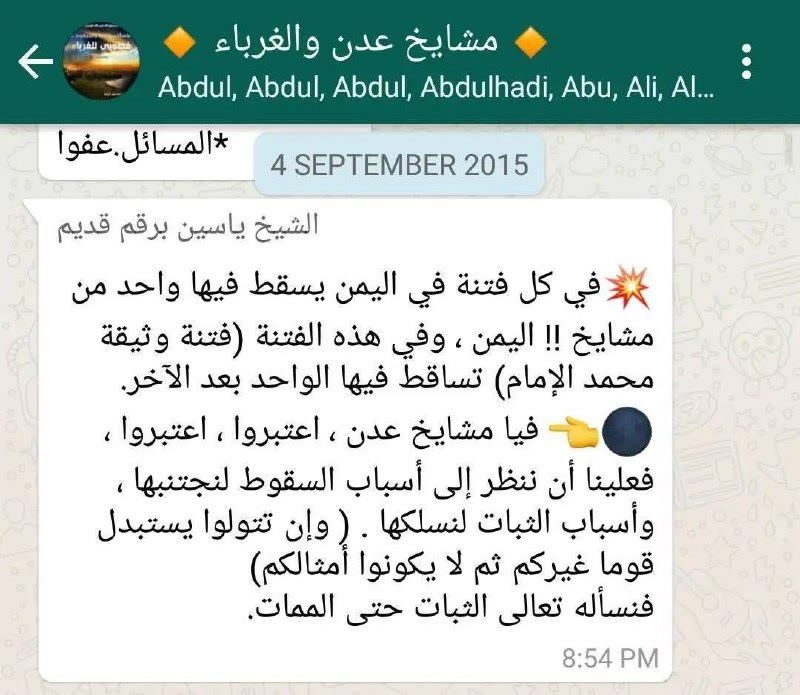
“We have found in every fitnah that our senior mashāyikh are the deeply-rooted people of knowledge [giving] wise advice, [having] true concern and penetrating insight:
—in the fitnah of the Muslim Brotherhood
—then the fitnah of the Quṭbiyyah
—then the fitnah of the Jamʿiyyāt
—then the fitnah of Maḥmūd al-Ḥaddād
—then the fitnah of al-Maghrāwī
—then the fitnah of al-ʿArʿūr
—then the fitnah of Abū al-Ḥasan [al-Mīṣrī]
—then the fitnah of Fāliḥ al-Ḥarbī
—then the fitnah of al-Ḥalabī
—then the fitnah of al-Ḥajūrī
And today, the fitnah of Muḥammad al-Imām which does not differ from all those that preceded it, and the ethics of his follower do not differ from the ethics of their predecessors (in fitnah).”
“The advice to those who wish to criticise the creed of any of the mashāyikh of Ahl al-Sunnah is to abandon prejudice and animosity, and write for the sake of Allāh the Exalted. Let them write in a (convincing) scholarly way, in the manner of the people of knowledge, (by which) the scholars know that this person genuinely holds an erroneous creed.
As for writing any speech and fabricating accusations, this does not find acceptance except among those who blindly follow every loudmouth. These are burdens which you will carry on your back.
These words of mine apply in the situation where the writer is trusted. However, if he himself has deviations in creed, I advise him to abandon prejudice against others and rectify his deviant creed regarding those in authority, aderence to the jamāʿah (united community) of the Muslims, and the unity of Muslim lands.”
Source: https://t.me/cashefattalbisat/277
Note : This is a response to the unscrupulous tactics used by those exposed for deviation. It is to trawl through cassettes and lectures in order to find errors to defame and degrade the critic(s). This is what ʿArafāt and his followers are engaged in after his deviations in creed and methodology were made clear.
Shaykh ʿAlī al-Ḥudhayfī, commenting on advice that people should not introduce foreign differences into their daʿwah and that many disagreements are personal ones clothed as methodological differences:
“When fitnah occurs among Ahl al-Sunnah, the source of error becomes apparent, and people recognise who is the deviant one, then everyone is able to speak in general terms about the necessity of uniting the word and cautioning from giving a reason to the enemies for rejoicing.
As for actually clarifying the truth, aiding the sincere advisor, and aiding the oppressor by counseling him and standing in opposition to his injustice, these are actions not performed except by very few from Ahl al-Sunnah who are rarer than red sulphur.
Some of them claim that these are personal disputes masked as manhaj (differences). Are rebellion against the state, treachery to scholars, spilling blood, aiding political factions and partitioning Yemen (merely) personal issues?
Are repeated insults directed towards scholars of Ahl al-Sunnah alongside endorsement of those who revile them considered personal issues?
Is there ruin to our businesses and properties (in these affairs, such that they have become personal issues for us)? Or do they comprise oppositions to our methodology and corruption of our youth?
Has your (view) changed regarding the affair of rebellion against the state and breaking away from the Muslim community, and splitting the country into two?
If your view regarding these affairs has changed or if you do not like to take sides, even if on the side of truth, then be brave. Do not clothe your silence regarding the truth with “giving advice”. For Allāh alone knows those who conceal their own errors.
Thereafter, even if we assume that these are personal issues, then the shaykhs of Ahl al-Sunnah are commanded, even in personal differences, to restrain the oppressor due to general texts. The Exalted said: “ And if one of them transgresses against the other, then fight against the one that transgresses until it returns to the command of Allah (49:9).”
Is this verse not general (in its application), applying even to personal disputes? Then how much more so, when there is a right and a wrong party (in the dispute)?
O mashāyikh: your silence from speaking the truth increases the fitnah and widens its scope. Perhaps a fitnah spreads due to the silence of a scholar about the truth more so than the innovator who initiated it.”
“If a scholar utters a statement that causes harm to the daʿwah or to a group of people, he is obligated to clarify the error and rectify it. If a problem arises within the daʿwah and people turn to him—and he is happy with their recourse to him—yet he leaves the matters unresolved (neither adjudicating them himself nor referring the people to someone else), then it becomes obligatory for him to speak, remaining silent is forbidden for him, or he must direct the people to another trustworthy scholar. In summary, a scholar may be obligated to express the truth; and if someone calls upon him to speak—because his words caused harm—then the person making that request bears no blame.”
“[Further], that scholar’s followers warn against an innocent person—a person of knowledge like him—who committed no offense other than offering advice for the sake of his religion and his homeland. These grievances are repeatedly brought to the scholar’s attention so that he might set matters right—for he is capable of averting harm from the oppressed with mere words—yet he fails to do so; he does not repel the injustice inflicted upon them. No matter how vigorously virtuous people defend you, their defense proves futile, because the prevailing view is that this specific scholar is the sole authority. Is this the way of the scholars of Ahl al-Sunnah? Far be it from the scholars of Ahl al-Sunnah to conduct themselves in such a manner.
Shaykh Rabīʿ, Shaykh Muqbil al-Wadiʿī, Shaykh al-Najmī, Shaykh ʿUbayd, and others—may Allāh have mercy on them—never remained silent regarding the oppression of the weak. Recall the day Abū al-Ḥasan (al-Maʾribi) accused us of Ḥaddādiyyah simply because we criticised him based on knowledge and under the supervision of those shaykhs; yet, they (i.e. those spreading these doubts today) did not defend us with a single word. Allāh averted that slander from us only through our father, Rabīʿ bin Hadi al-Madkhalī—may Allah have mercy on him and forgive him. [The poet said]: Gone are those in whose shelter one lived, And left behind is a remnant like the hide of a mangy beast .”
“It was your duty, […] to direct your harsh words to those who deserved it, those who committed crimes against the daʿwah. Then, regardless of the fitnah, it is incorrect for your initial statements that were quoted to be stated in this way to begin with. Rather, providing detail is necessary, and everyone who has a share in knowledge knows this, and their evidence is too famous to be mentioned. Among them is the Exalted’s saying: “ You will make it clear to the people, and do not conceal it .” And his saying: “ Had the learned scholars not forbidden them from speaking sinfully and eating unlawful things ,” and his saying: “ They would not forbid an evil they did, ” and the saying of the Prophet of Allāh, Jesus: “ And I will make clear to you some of that in which you differ .” And other texts indicating that clarification is sometimes obligatory for scholars.” End of speech of Shaykh ʿAli.
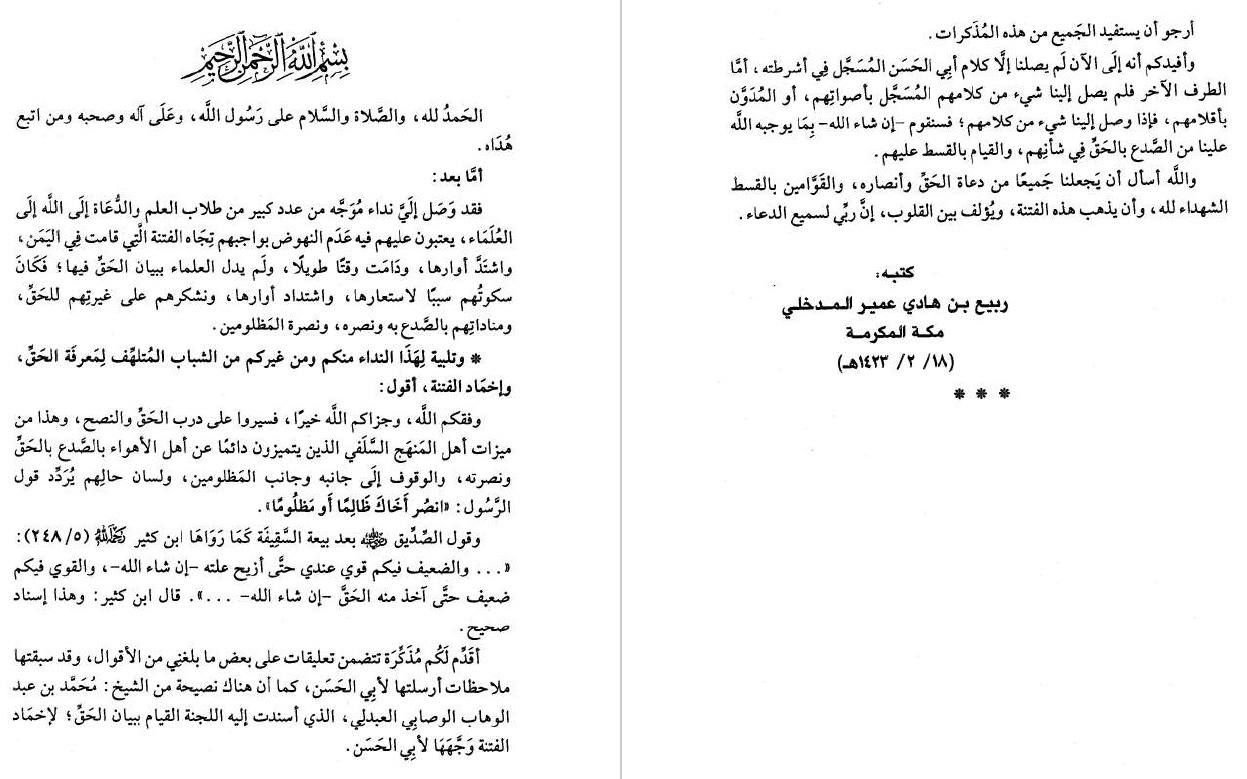
Allāmah Rabīʿ—may Allāh shower abundant mercy upon him—said in his treatise Iʿānah Abī al-Ḥasan ʿalā al-Rujūʿ Billatī Hiya Aḥsan (Assisting Abu al-Hasan in Retracting in the Best Manner) found in Majmūʿ Muʾallafāt al-Shaykh, 13/53–54):
In the Name of Allāh, the Most Merciful (to His creation), the Ever Merciful (to His believing servants).
All Praise is due to Allāh; and may peace and blessings be upon the Messenger of Allāh, his family, his companions, and those who follow his guidance.
To proceed:
I have received a unified call from a large number of students of knowledge and callers to Allāh directed to the scholars. In it, they reproached the scholars for not embarking upon their duty regarding the tribulation (fitnah) that arose in Yemen, one that has has intensified and persisted for a long time without the scholars clarifying the truth regarding it. Rather, their silence contributed to the fanning of its flames and its escalation. We thank the (students and callers) for their zeal for the truth and their call (for the scholars) to proclaim it openly, to aid it, and to aid the oppressed.
And responding to this call—from you and from other young people eager to know the truth and for the fitnah to be suppressed—I say:
May Allāh grant you success and reward you with good. Proceed upon the path of truth and giving sincere advice. This is from the distinctions of the followers of the Salafi manhaj, who are always distinguished from the people of desires by their open declaration and aid of the truth, and by standing with the truth and the oppressed.
The position taken by them reflects the saying of the Messenger (صَلَّى اللهُ عَلَيْهِ وَسَلَّمَ): “Aid your brother, whether he is an oppressor or oppressed,” and the words of al-Ṣiddīq (رَضِيَ اللهُ عَنْهُ) following the pledge of allegiance at Saqīfah—as reported by Ibn Kathir (رَحِمَهُ اللهُ) (5/248): “The weak among you is strong in my view until I restore his rights to him, if Allah wills; and the strong among you is weak until I exact justice from him, if Allah wills.” Ibn Kathir commented: “This is an authentic chain (isnād.”
I present to you a memorandum containing remarks on some statements that have reached me. It is preceded by some observations I have sent to Abū al-Ḥasan. Also included is advice to Abū al-Ḥasan from Shaykh Muḥammad bin ʿAbd al-Wahhāb al-Wasābī al-ʿAbdali to whom the Committee had assigned the duty of clarifying the truth and suppress the fitnah. I hope that everyone benefits from this memorandum.
I would also like to inform you that, until now, we have received only the words of Abū al-Ḥasan as recorded in his tapes. As for the other party, nothing has reached us—neither words recorded in their own voices nor statements written by their own hands. Should any of their statements reach us, we shall—if Allāh wills—fulfill the obligation Allāh has placed upon us to openly declare the truth regarding them and to establish justice in their case.
I ask Allāh to make us all callers to the truth and its helpers, upholders of justice, and witnesses for Allāh, and to remove this tribulation and unite hearts. Indeed, my Lord hears all supplications.
Written by Rabīʿ bin Hādī ʿUmayr al-Madkhalī, 18/2/1423 AH | Makkah al-Mukarramah
Iʿānah Abī al-Ḥasan ʿalā al-Rujūʿ Billatī Hiya Aḥsan (Assisting Abu al-Hasan in Retracting in the Best Manner) found in Majmūʿ Muʾallafāt al-Shaykh, 13/53–54)
"ʿArafāt al-Muḥammadī and his clique have been forced to issue statements of support for the fight against the Houthīs behind the ruler, with their knowledge that they were complicit in rebellion and sedition against him by meeting with the rebel leaders, withholding information about Hānī bin Burayk from Shaykh Rabīʿ, and supporting the STC rebel forces. Shaykh ʿAlī made a post expressing support and encouragement for the leader, Rashād al-ʿAlīmī, and ʿArafāt al-Muḥammadī, suspected of using the pseudonym "Ibn Abī ʿAbd al-ʿAzīz" wrote a post against him accusing him of sycophancy towards the ruler. So Shaykh ʿAlī al-Ḥudhayfī responded to his treacherous behaviour with the post below."
Shaykh ʿAlī al-Ḥudhayfī said:
“O Dr. ʿArafat al-Muḥammadī, O you who hide behind pseudonyms:
How did you come to know that I am involved in sycophancy? Have you peered into my heart?
When our Shaykh, Shaykh Rabīʿ al-Madkhalī (رَحِمَهُ اللهُ), praised King Salmān for Operation Decisive Storm, was he being sycophantic, or was he encouraging the rulers toward this great good?
And from what am I supposed to repent? Am I to repent for supporting the rulers and letting them know that the people stand with them—actions which you label as defamation?
Let’s assume that I were to repent from that, then would you repent for the bloodshed you helped to cause, and the rebellion against the state in which you were complicit?
Will you repent for your repeated disparagement of Shaykh al-Albani—attested to by witnesses—mocking him in private gatherings?
Will you repent for betraying Shaykh Rabīʿ by withholding information from him to extract a fatwā, and concealing his statements regarding the disparaged (ones)?
Will you repent for the fitnah (tribulation) you have ignited everywhere?
Will you repent for fighting people, not for the sake of Allāh, but because they recognized you as an infiltrator planted by certain parties to sow chaos in Yemen and within the Salafi daʿwah?
By Allāh, I doubt that you even consider the Yemeni President, Rashād al-ʿAlīmī, to be the legitimate ruler.
Your recent tweet was but an act of duplicity; you only issued it after facing severe backlash for your suspicious silence and that of your followers regarding the jihād against the Ḥouthis. Even then, you left obvious loopholes in it. The Exalted said: “ Or do those in whose hearts is a disease think that Allah would not expose their hidden hatreds? ” (47:29).
So, make an explicit statement declaring that your legitimate ruler is the Yemeni leader, Rashād al-ʿAlīmi and ask the young people you have led astray to pledge obedience to the leader and warn them against believing that he is not a legitimate ruler.”
Welcome, and may Allah greet you well, my brother.
Regarding your question about this phrase: “Do not interfere between the mashayikh”, or “Leave matters involving dispute or disagreement among the mashayikh”, this statement, when taken absolutely without qualification, is open to scrutiny.
If the issues circulating among scholars or people of knowledge are matters that cannot be fully grasped by everyone in the field of seeking and acquiring knowledge—requiring instead senior scholars who possess the necessary scholarly depth and qualifications, and involving ijtihad and scholarly exchange—then undoubtedly, it is not permissible to interfere in these matters.
They are more knowledgeable and better informed, possessing qualifications not found in those of a lower rank, whether they be beginner or intermediate students of knowledge, or the general public.
In this context, the statement holds true, supported by the authentic Sunnah: “Part of the perfection of a person’s Islam is leaving alone that which does not concern him.” Scholars often discuss contemporary jurisprudential issues that require ijtihad and careful examination to arrive at a Shari’ah ruling or a jurisprudential opinion; in this regard, the statement is valid.
However, if the issues currently present in the arena are matters of methodology (manhaj) or creed (‘aqidah)—where truth is opposed by falsehood, and there are divisions between parties, yet the truth is undoubtedly clear, supported by Shari’ah evidence and the established stance of scholars—then it is obligatory to champion the truth and its proponents.
Students must be advised to follow the truth and what is correct, and to support that truth and those who uphold it. This is the obligation.
The controversial issues present today are significant matters that have already been settled by Allah’s law; they have been resolved by our scholars and studied by Salafis and students alike. These principles are fundamental and clearly established in the Book of Allah, the Sunnah of His Messenger (صَلَّى اللهُ عَلَيْهِ وَسَلَّمَ), and scholarly texts.
They include matters such as hearing and obeying those in authority and not rebelling against them; fighting the Kharijites alongside the rulers; standing with Muslim armies against aggressors, Kharijites, and rebels; and upholding truthfulness, adopting it as a motto, a way of life, a call to others, and a standard of discourse.
These are clear matters; whoever contradicts them should be counseled. If they do not heed the counsel, they should be shunned, and others should be warned against them. Scholars active in the field ought to address these issues and guide students of knowledge to adhere to them in accordance with Shari’ah, to hold fast to them, and to support both these principles and those who uphold them. This is the reality of the situation today.
However, if we tell students, ‘Remain silent, do not speak, do not follow, and do not get involved,” deviation will inevitably occur. Students who harbour a good opinion of their sheikh or teacher will be left in a state of total blindness, misled and confused, because their teacher failed to clarify the truth and the correct path, or to distinguish between those who are right and those who are wrong.
Consequently, they will find themselves adrift in a sea of bewilderment, chaos, and loss. True counsel to students of knowledge involves telling them: ‘This is the truth, so adhere to it; these people have upheld it, so stand with them—not out of personal attachment, but because they have spoken the truth. Conversely, those others have contradicted the truth and are upon falsehood, error, and deviation, so beware of them, stay away from them, and avoid their path.’
This is the counsel due to every Muslim, let alone students of knowledge who seek the pleasure of Allah and the pursuit of knowledge. Why do they acquire this knowledge? To distinguish truth from falsehood, to follow the truth, and to abandon falsehood.
When we issue such statements [discouraging engagement], we only exacerbate strife and confusion, and we raise a generation that is lost, wandering aimlessly, unable to distinguish between truth and falsehood. We would remain silent regarding the support of the truth and its adherents, and remain quiet, Allāh forbid, at times when we ought to speak, guide, and instruct.
Therefore, voicing such a statement in a context marked by disagreement over fundamental principles of methodology and creed—and by a conflict between two factions, one calling for the truth and adherence to the legitimate foundations and established tenets of Islam, and another opposing all of this—requires us to champion the truth and its people. We must avoid expressions that cause confusion or leave students feeling lost, lacking in resolve, and misled.
Everyone here must support the truth and its adherents, and aid the oppressed—just as the Prophet (صَلَّى اللهُ عَلَيْهِ وَسَلَّمَ) said: “Aid your brother, whether he is an oppressor or oppressed.” We must not be among those who discourage or abandon the cause, nor among those who oppose the truth and its people.
Consequently, using such expressions in this context is questionable and open to objection; it leads to confusion and misconceptions in the minds of students of knowledge, students for whom we desire goodness, awareness, and deep understanding. We want them to be men who boldly proclaim the truth and offer sincere counsel to others, rather than being individuals who are irresolute or indifferent. And Allah knows best.
"The majority of those who fall during tribulations are :
First: The blind-follower who surrenders his intellect to another person, following them in everything without bothering to investigate the truth. He may be a good person seeking the truth, yet he falls because he suspended his intellect during this tribulation
Second: The fearful person who fears taking a position lest he be criticised, loses favour with people, or sees them abandon him. Some even outwardly display what is contrary to their inner beliefs (in the matter). This is not from prudence (mudārāt) but rather it is from duplicity and posturing at the expense of the truth. If students of knowledge engage in such posturing, then who will speak the word of truth?
Third: The opportunist who pursues his own self-interest—whether it be an endorsement (tazkiyah), money, status, or otherwise. Such a person is not saddened by the weakness of the truth or the ascendancy of falsehood. Rather, his sadness only arises when his personal interest (through the matter) is lost.
Fourth: The vengeful person who enters the tribulation only to settle scores. We have known (from experience) that such types may surface and spout rhetoric for a time, but Allāh eventually removes them, and the daʿwah is relieved of them.
Fifth: The infiltrator recruited by people to achieve specific agendas from within the daʿwah. Most of these types may wield much influence initially by distorting facts and buying loyalties, but they are ultimately exposed and defeated because this is Allāh’s religion, and Allāh is the Guardian of His religion, and it is the truth that is aided (to victory).
1. Shaykh Muqbil al-Wādiʿī: The realities will be exposed, and the confusion will disappear, no matter how hard the impostors try to obscure the truth.
2. Shaykh ʿAbd al-Raḥmān al-Muʿallimī al-Yamānī: The Effect of Enmity on the Acceptance of Testimony
(Refutation of the doubt raised by Aḥmad Bādkhan and others among the tails (followers) of the “New Party,” which is their rejection of the testimonies of the Salafis, claiming that testimony whose origin is enmity is not accepted.)
8. This Is the Truly Upright and Rightly Guided Man, O Dr. Abdullah al-Bukhari
[The truly upright and rightly guided man is the one who repels the people of evil and transgression, supports the oppressed, and relieves the distress of those afflicted with hardship. He is not the one who lets down the Muslims and places the rulers on an equal footing with the Khawārij.]